




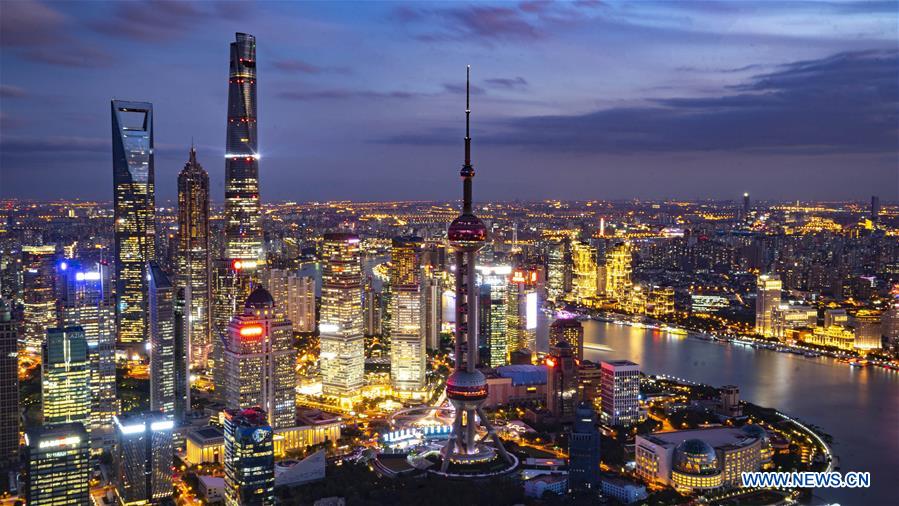
Photo taken on Nov. 1, 2018 shows a night view of Shanghai, east China. (Xinhua/Cai Yang)
HEFEI, May 28 (Xinhua) -- Chen Dejun, a 28-year-old teacher in the eastern Chinese city of Hangzhou, is excited that she can now ride the subway to another city 330 km away with the same app on her phone.
"My boyfriend works in Hefei. I travel there almost every month to meet him, and he comes to visit me every month too," said Chen.
Chen is just one of the tens of millions that can benefit from 10 cooperative agreements signed by officials from Shanghai and the provinces of Jiangsu, Zhejiang and Anhui last week to accelerate regional integration of the Yangtze River Delta, already a national strategy.
Covering a wide range of areas such as transportation, industries, technology and people's livelihoods, the deals are mainly designed to tackle administrative barriers and promote the flow of people and goods in the delta region.
One agreement allows people to take subways of seven cities in the region, including Shanghai, Hangzhou, Nanjing and Hefei, with the same app.
"It seems like an easy step, but it needs a large amount of hardware upgrading and software debugging and breaking of many barriers," said Jing Xiandong, chairman of Ant Financial, Alibaba's financial affiliate.
The Yangtze River Delta should play an exemplary role in seeking regional integration and high-quality development to boost the development of the Yangtze River Economic Belt and east China and build a regional cluster of high-quality development, according to a statement issued after a meeting held by the Political Bureau of the Communist Party of China Central Committee in mid-May.
The delta region takes up only one twenty-sixth of China's territory and one-sixth of its population but creates almost one-fourth of the country's gross domestic product.
EASIER TRANSPORT
The four localities have made transportation interconnection, particularly the high-speed railway, a priority for the regional integration.
The main structure of a new railroad bridge over the Yangtze River in the city of Wuhu in Anhui was completed last month, paving the way for the operation of the Shangqiu-Hefei-Hangzhou high-speed railway in 2020.
With a designed maximum speed of 350 km per hour, this railway will help further cut the travel time between Hefei and Hangzhou, the capital cities of Anhui and Zhejiang.
Last December, a high-speed railway linking Hangzhou and Huangshan was opened, significantly shortening the travel time between the two scenic cities.
"I frequently travel between the two cities because my wife works in Hangzhou," said Song Lipeng, who lives in Huangshan of Anhui. "I used to travel by car, but it is more convenient and comfortable with this new rail line," said Song.
According to statistics, at least 85 cities in the region offer high-speed railway services. With the accelerated transportation infrastructure construction, the dream of "1-3 hour life circle" within the region is becoming a reality.
The city of Suzhou is even building a subway to connect with Shanghai's metro system.
BETTER COORDINATION
The Yangtze River Delta is one of China's most dynamic regions with the highest-level opening-up and the strongest innovation capability. It is a robust driver of China's economy and a major window on China's national competitiveness.
Nowadays, Shanghai, Jiangsu, Zhejiang and Anhui are coordinating efforts to draw a common blueprint, instead of developing their own ones.
The localities are seeking to build a scientific innovation community amid other joint efforts to improve the inter-city railway network and fight pollution.
The region is coordinating a modern layout to build world-class industrial clusters in fields of integrated circuits, artificial intelligence, biomedicine, high-end equipment, new materials and new energy vehicles, and seeking to use the innovation community to make breakthroughs in several key technologies.
As the Yangtze River Delta integration pushes forward, more institutional and systematic results are yielding, said Ma Chunlei, head of the Shanghai Municipal Development and Reform Commission and the Yangtze River Delta Regional Cooperation Office.
"Now the one municipality and three provinces have a shared action plan," said Ma.
Yu Quan, who runs a company in the city of Xuancheng in Anhui, is a beneficiary of the integration. It only took him three days to get the registration certificate for the research center he established in Shanghai.
"I would have to go to Shanghai to apply for the certificate before. Thanks to the new policy, I could easily get it in Xuancheng and it saved me a lot of trouble," said Xu, referring to a mechanism established last year.
In June 2018, nine districts and cities in the region created a mechanism called "G60 science and technology innovation corridor," aiming to build an integrated development platform driven by scientific, technological and institutional innovation.
GLOBAL COMPETITION
Shanghai, Jiangsu, Zhejiang and Anhui, which have never been as connected as today, are working together to develop the region into a strong and robust growth pole and a globally competitive world-class city cluster.
From small chips to big planes, and from cloud computing to the Internet of Things, the four places are teaming up to promote further integration of industrial chains.
"As time goes by, the region is becoming more and more dynamic and appealing. Geographic proximity and similar cultures have nurtured friendship among its cities. At the same time, cities in the region can also complement each other in terms of industrial chains," said Xu Xianping, a professor at Guanghua School of Management with Peking University.
"The region will explore a high-level regional integration model for the country to lead the high-quality development of the Yangtze River Economic Belt," said Xu.
Facing rising trade protectionism and unilateralism on the world stage, the region should promote experience from the Shanghai Pilot Free Trade Zone to boost trade and investment liberalization and facilitation and improve the business environment, said Xu.
"The Yangtze River Delta shoulders an important responsibility and a glorious mission in participating in the high-level global cooperation and competition," said Xu.
(Video reporters: Cao Li, Sun Qing, Sang Tong; Video editor: Yin Le)
