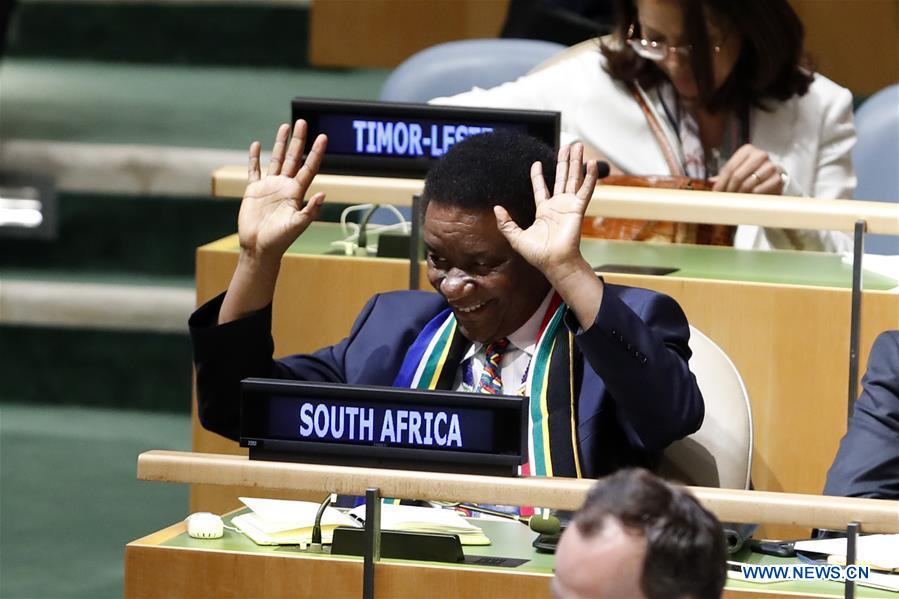
South African Ambassador to the United Nations Jerry Matthews Matjila reacts after South Africa was elected as non-permanent member of the UN Security Council, at the UN headquarters in New York, June 8, 2018. The UN General Assembly on Friday elected South Africa, Indonesia, the Dominican Republic, Belgium, and Germany to serve during 2019-2020 in the UN Security Council. (Xinhua/Li Muzi)
UNITED NATIONS, June 8 (Xinhua) -- The UN General Assembly on Friday elected South Africa, Indonesia, the Dominican Republic, Belgium and Germany to serve during 2019-2020 in the UN Security Council.
Germany and the Dominican Republic each received 184 votes in favor, South Africa 183, Belgium 181 and Indonesia 144.
The Council is the only UN body that can make legally binding decisions and has the power to impose sanctions and authorize the use of force. Winning a seat on the Security Council is a great achievement for many countries because they could express fully and explicitly on major international peace and security issues.
The elected five are to join on Jan. 1, 2019 the five permanent members of the 15-nation council -- Britain, China, France, Russia and the United States and replace the five non-permanent members elected in 2016 to serve during 2017-2018 -- Ethiopia, Kazakhstan, Bolivia, the Netherlands and Sweden, who are ending their two-year terms (excluding the Netherlands) on Dec. 31 this year.
During the 2016 Security Council elections, Italy and the Netherlands agreed to split a two-year term, in which Italy would serve from Jan. 1, 2017 to Dec. 31, 2017 and the Netherlands would subsequently serve from Jan. 1, 2018 to Dec. 31, 2018 because Italy and Netherlands were tied 95-95 after a total of five rounds of secret ballots.
Six member states -- South Africa, Indonesia, the Maldives, the Dominican Republic, Belgium and Germany were running for the five available seats. Indonesia and the Maldives were contesting the one available seat for the Asia-Pacific Group, while the other four candidates ran unopposed.
The Maldives received 46 votes in favor.
A country must obtain the votes of two-thirds of the member states present and voting at the General Assembly session in order to secure a seat on the Council, regardless of whether the election is contested. This means that a minimum of 129 positive votes are required to win a seat if all 193 UN member states are present and voting.
Altogether 190 member states cast votes for the Asia-Pacific Group election and a minimum of 127 votes were required to secure a seat.
The East European Group is not contesting any seat this year as its seat, held by Poland through 2019, comes up for election every other year.
Among the six candidates, four have previous Council experience. Belgium and Germany have served five times, Indonesia three times, and South Africa twice. The Dominican Republic and the Maldives have never served on the Council.
More than 60 UN member states have never been members of the Security Council.
In accordance with the Security Council's rotation rules, whereby the 10 non-permanent UNSC seats rotate among the various regional blocs into which UN member states traditionally divide themselves for voting and representation purposes. The five available seats this year were allocated as follows: one for the Africa Group, one for the Asia-Pacific Group, one for the Latin America and the Caribbean Group, and two for the Western European and Others Group (WEOG).
Israel, which did not belong to any group for many years, was given temporary membership in WEOG in May 2000. It had previously planned to contest for the seat allocated for WEOG, but dropped out recently, leaving other WEOG members-Belgium and Germany unopposed.
The General Assembly mandated in 2014 that elections beginning in 2016 for non-permanent Security Council seats be held six months in advance of the term in order to give the elected countries more time to prepare for their new responsibilities.
Previously balloting was held in October.
This was the third Council election since the timing was brought forward from October to June. As a result, the incoming members enjoy a longer preparatory period, including three months of participation as observers in Council consultations of the whole, Council subsidiary bodies, and some informal Council meetings.
Diplomats say that the candidates appear to have a strong national interest in particular regional issues and country-specific situations on the Council's agenda.
South Africa can be expected to emphasize African issues, which make up a significant portion of the Council's workload. In its previous two terms on the Council, in 2007-2008 and 2011-2012, South Africa advocated closer cooperation between the UN Security Council and the AU Peace and Security Council, on the basis that this would enhance the effectiveness of the UN Security Council in addressing challenges to peace and security in Africa.
The Dominican Republic is also likely to take a keen interest in its own region, in particular the situation in Haiti, given its proximity.
With the possibility that the UN Mission for Justice Support in Haiti may draw down or even close in the coming years, it is likely that the Dominican Republic will seek to influence this process so as to promote stability.
Germany has expressed interest in engaging closely on several issues on the Council's agenda. High on its list of priorities are the Syrian conflict, Libya, Yemen, and what it has described as the migration crisis.
Shortly before setting off to New York to attend the vote, German Foreign Minister Heiko Maas told reporters in Berlin: "Especially in the current situation, we need a strong and empowered United Nations."
This year's candidates seem to have a shared interest in thematic issues concerning the protection of civilians, including children in armed conflict; women, peace and security; and youth, peace and security.
The conflict prevention and sustaining peace agenda is another common priority among this year's candidates, which is also in line with the Secretary-General's renewed emphasis on these issues.
Current divisions within the Council over issues including Syria and Israel/Palestine are likely to persist following the departure of the five current non-permanent members and the arrival of the five newly elected members, according to an analysis report of the Security Council Report, Inc.
A state which is a member of the United Nations but not of the Security Council may participate, without a vote, in its discussions when the Council considers that country's interests are affected.