By Xinhua writer Yu Fei
BEIJING, May 22 (Xinhua) -- How did our cosmos emerge from darkness after the Big Bang? How were the earliest stars ignited in the cosmic dawn?
Chinese scientists will look for answers on the far side of the Moon.
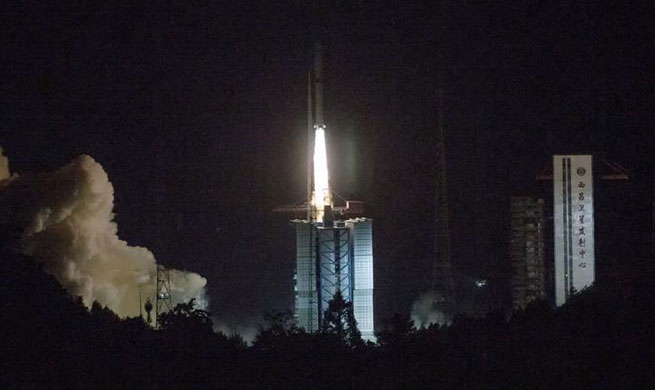
China on Monday launched the Queqiao ("Magpie Bridge") relay satellite to help communicate with the Chang'e-4 lunar probe, which is expected to soft-land on the far side of the Moon at the end of this year.
Two micro satellites, Longjiang-1 and Longjiang-2, will also be sent to orbit around the Moon to conduct ultra-long-wave astronomical observation, which could help scientists explore the dawn of the universe.
The cosmos entered its "dark ages" after the Big Bang. Under the action of universal gravitational forces, the primordial perturbation gradually grew and led to the formation of the first stars and galaxies, ushering in the dawn of the universe, said Chen Xuelei, a cosmologist with the National Astronomical Observatories of the Chinese Academy of Sciences (CAS).
"The study of the cosmic dawn is a new focus in academic circles. When did the cosmic dawn start? How were the first stars ignited? How big were the earliest stars? We only have conjecture about those questions, and we need astronomical observation to help us find the answers," said Chen.
Scientists speculate that during the dawn of the universe, neutral hydrogen might have generated an absorption signature at the wavelength of 21cm.
"That is like the rosy cloud of the dawn. We are looking for such characteristics of the cosmic dawn through ultra-long-wave astronomical observation," Chen said.
Scientists from the United States, Australia, India and other countries have set up astronomical instruments in many places around the globe to look for the "rosy cloud", but no reliable observation results have been achieved so far.
The ionosphere, the ionized part of the Earth's upper atmosphere, as well as electromagnetic radiation generated by human activities on Earth, would seriously interfere with the observations.
"So we need to go to outer space to conduct such observation," Chen said.
Astronomers yearn for a completely quiet electromagnetic environment to detect the weak signals emitted from remote celestial bodies in deep space.
The far side of the Moon is such a place, as the body of the Moon shields against the radio interference from the Earth. And from there, astronomers can study the origins and evolution of stars and galaxies, peering into the dawn or even the dark ages of the universe.
The United States sent two satellites into space, with one orbiting the Moon, to conduct ultra-long-wave astronomical observations in the 1970s. But restricted by the technologies at that time, the results were not satisfactory, said Chen.
He is one of a group of Chinese and Dutch scientists who have proposed a new program to send a fleet of satellites, including a main satellite and several small ones, to orbit the Moon. When they fly to the far side, they will conduct observations, and when they fly to the near side, they will send data back to Earth.
The Longjiang-1 and Longjiang-2 micro satellites, launched together with Chang'e-4's relay satellite, will conduct an initial test for the program.
The micro satellites were jointly developed by the Harbin Institute of Technology and the National Space Science Center of the CAS. Chen will lead a team of scientists responsible for analysis of the data.
"Exploring the cosmic dawn is our long-term goal, and Longjiang-1 and Longjiang-2 are only a preliminary experiment. We face a lot of restrictions, since the devices on the micro satellites might also cause notable electromagnetic interference, and the observation time will not be long enough," Chen said.
But this experiment could lay the foundation for future exploration, he added.
Chinese scientists have started to develop the key technologies for use in future exploration.
The relay satellite and the lander of the Chang'e-4 lunar probe are also equipped with low-frequency radio spectrometers, developed by Dutch and Chinese scientists, which will conduct similar observations, helping scientists to "listen" to the deeper reaches of the cosmos.