
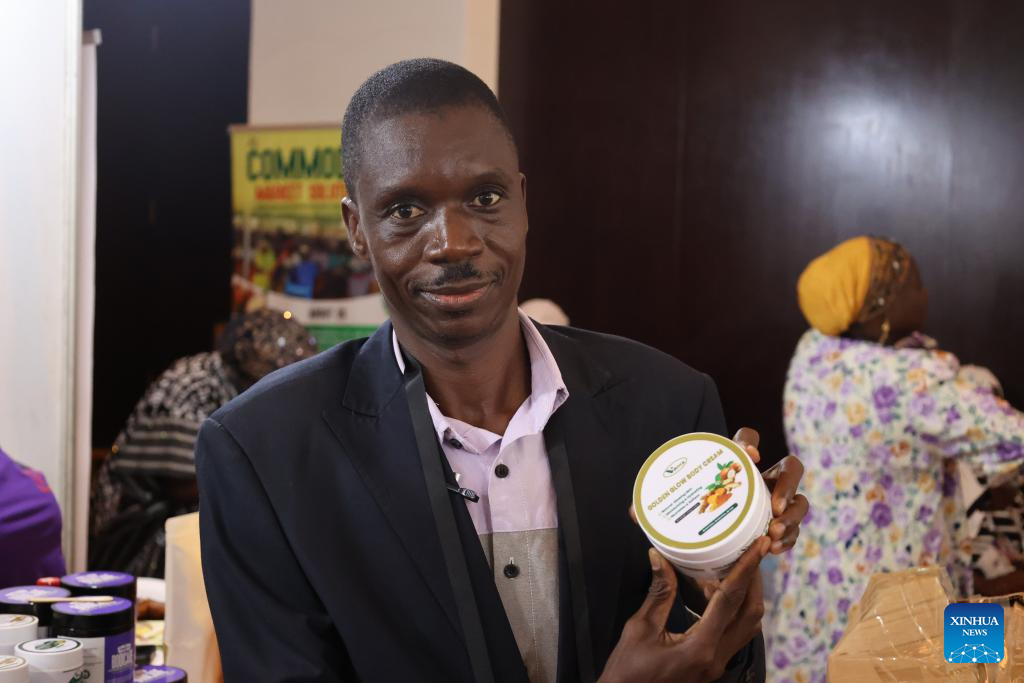
Daniel Kombat, chief executive officer of Danikom Ghana Limited, a producer of natural shea butter and African black soap, poses for photos with shea butter products at an exhibition stand during the Shea 2026 conference in Accra, Ghana, April 28, 2026. Daniel Kombat has said that his company is preparing to capitalize on opportunities in the Chinese market following China's expansion of zero-tariff treatment to all African countries that have diplomatic relations with it, effective May 1.
by Justice Lee Adoboe
ACCRA, April 29 (Xinhua) -- A Ghanaian exporter has said that his company is preparing to capitalize on opportunities in the Chinese market following China's expansion of zero-tariff treatment to all African countries that have diplomatic relations with it, effective May 1.
Daniel Kombat, chief executive officer of Danikom Ghana Limited, a producer of natural shea butter and African black soap, told Xinhua on Tuesday that the policy offers African exporters an alternative market as a new U.S. tariff regime erodes their earnings.
His business, based in Tamale, the capital of Ghana's Northern Region, was established in 2011 and employs 1,000 women to collect shea nuts, as well as 421 others engaged in the organic and conventional processing of shea butter and African black soap -- the company's flagship products.
Over the years, the company has developed export markets in the United States, Poland, Italy, Canada, and Bulgaria. Following the launch of the African Continental Free Trade Area (AfCFTA), it has also expanded into African markets.
"We're now exporting to South Africa, one of the African markets we want to enter. We want to take advantage of the AfCFTA, so we started exporting to countries like Botswana, Zambia, and Kenya, and now we have one of the biggest markets in Africa, which is South Africa," he stated.
According to him, the United States has been one of the company's biggest markets, benefiting from the African Growth and Opportunity Act. However, recent tariff changes have made the U.S. market less attractive, prompting the company to explore alternative destinations offering more favorable trade terms.
"Today, we are looking at China, and China has the market. We want to take advantage of this market. So, this year, we are going to China to exhibit during the Canton Fair, which comes off sometime later in the year," Kombat disclosed.
"We anticipate high demands from China because Chinese businesses can ask for 500 metric tons at a time, and going into that market, we need to strategize to build capacity and also expand to produce more than we currently do to take advantage of the opportunity," he said.
He described the prospects for African exporters under China's zero-tariff regime as "enormous," noting that Africa supplies key raw materials, many of which can be processed into finished or semi-finished goods.
"I see it as a win-win situation, which can help to balance the trade between Africa and China and help African economies to grow. But African governments must also create the right conditions for their exporters to grow and take advantage of the opportunities offered by China," he said. ■