




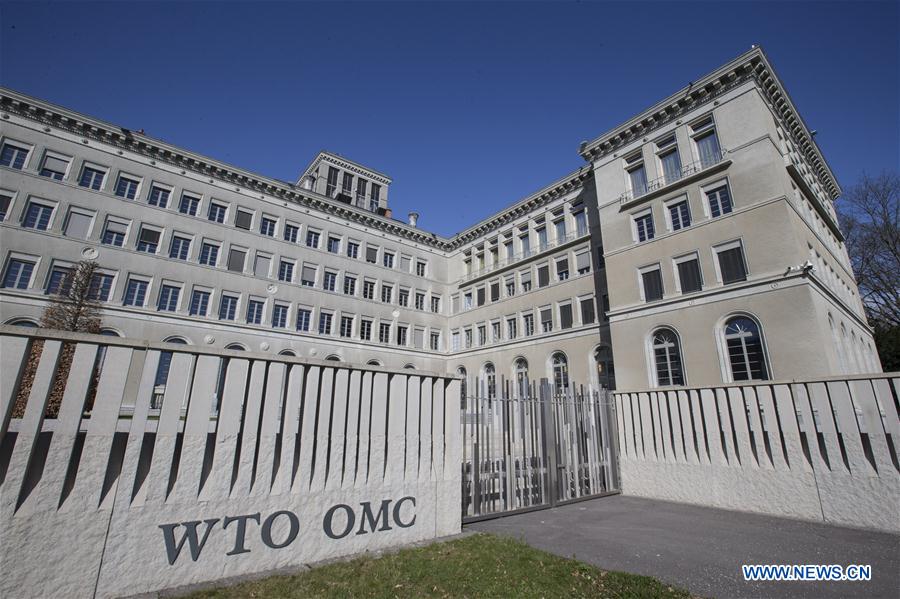
Photo taken on April 4, 2018 shows the World Trade Organization (WTO) headquarters in Geneva, Switzerland. (Xinhua/Xu Jinquan)
BEIJING, April 4 (Xinhua) -- Washington Tuesday published a proposed list of Chinese goods subject to additional 25 percent tariffs amid strong opposition from China and U.S. business groups, the latest unilateralist and protectionist action taken by the United States to escalate the trade tensions between the world's two largest economies.
The proposed list covers approximately 1,300 Chinese products, including industries such as aerospace, information and communication technology, and robotics, whose annual trade value is about 50 billion U.S. dollars.
To defend its legitimate rights, China plans to immediately bring relevant U.S. practice to the World Trade Organization (WTO), and is ready to take countermeasures on U.S. products with equal force and scale.
Analysts said the United States has been playing a game of slapping tariffs one by one on its trading partners to force concessions in bilateral negotiations.
By wielding the tariff stick, the United States is jeopardizing the international market and posing a serious threat to global trade rules.
CHINA TO FIGHT BACK IN SELF-DEFENSE
The announcement of unilateral measures by the United States against China under its domestic Section 301 investigation is an intentional and gross violation of the WTO's fundamental principles of non-discrimination and bound tariffs, Zhang Xiangchen, Chinese ambassador to the WTO, said Wednesday.
"The findings of the U.S. Section 301 investigation are a willful distortion of facts and full of selective assertions and allegations, turning a blind eye to the actual progress that China has achieved in the market-oriented reforms, further opening-up and enhanced intellectual property protection," said the diplomat.
Zhang called on all WTO members to lock arms with China in fighting the blatant protectionist acts of the United States.
"Disregarding strong representations by China, the United States announced the tariff proposals that are completely unfounded, a typical unilateralist and protectionist practice that China strongly condemns and firmly opposes," said China's Ministry of Commerce (MOC) on Wednesday.
China plans to immediately bring relevant U.S. practice to the dispute settlement body of the WTO, and is ready to take countermeasures on U.S. products with equal force and scale that will be published in the coming days.
"We have the confidence and ability to respond to any U.S. trade protectionist measures," said a MOC spokesperson.
Chinese Foreign Ministry also made a response Wednesday, saying the U.S. tariff proposals are a "typical unilateralist and protectionist action."
Despite strong warnings from business groups and trade experts, U.S. President Donald Trump signed a memorandum on March 22 that could impose tariffs on Chinese imports and restrictions on Chinese investment in the United States.
The memorandum is based on a so-called Section 301 investigation, launched by the Trump administration in August 2017, into alleged Chinese intellectual property and technology transfer malpractices.
The move came after the U.S. administration took an increasingly hawkish turn on its trade partners including China, as it blamed its trade deficit with major trading partners for its domestic economic woes and job losses.
TARIFFS SLAPPING GAME
The recent month has witnessed a series of unilateral actions from the United States to slap tariffs on its trading partners, evoking concerns about a trade war and further damage to the current global trade system.
At the beginning of March, Trump's administration announced that the United States would impose 25 percent of tariff on steel imports and 10 percent for aluminum, which is more like a bargaining stick rather than true tariffs to urge trade partners to compromise.
Later, Washington announced that it would grant exemptions from the steel and aluminum tariffs to key U.S. allies and trade partners including the European Union, Canada, Mexico, South Korea and Australia, after urging its "real friends" to compromise.
These moves are only the tip of the iceberg of Trump's grand tariff-slapping plan. Calling trade wars "good, and easy to win," Trump's administration crushed hopes of progress in talks of the North American Free Trade Agreement (NAFTA), raising fears among Canada and Mexico about the trade deal's future.
At the end of March, the United States sparred with China at the WTO over the legality of the high tariffs on Chinese products based on Section 301, after it took unilateral actions, ignoring the WTO rules.
"The U.S. focus is on the advanced manufacturing sectors that China wants to become a global leader in," Louis Kuijis, head of Asia Economics with Oxford Economics, wrote in an article.
"However, there are risks of much more serious trade friction. During the announcement of the memorandum, President Trump said this measure will be the 'first of many,' underscoring the risk of escalation," Kuijis added.
POLITICAL INTENTIONS DISTURB FAIR TRADE MARKET
"The recent action by U.S. President Trump to slap tariffs on China outside of the established WTO rules ... is troubling," said Tom Watkins, an advisor to Michigan-China Innovation Center.
"While it has some short-term political benefit to President Trump's political base of disenfranchised voters, it is unlikely to have any significant long-term economic benefit to working class people in America, nor address the real issue of free and fair trade imbalances," Watkins said.
Echoing the view, Justin Yifu Lin, former chief economist of the World Bank, called the U.S. move to impose high tariffs against China "politically motivated," which will "fly in the face of reciprocity, contradict the win-win principle of trade, and jeopardize the interests of U.S. voters."
In an online article released by Project Syndicate, Lin said: "East Asia, including China, is not the main cause of the rapid expansion of the U.S. trade deficit."
U.S. consumers will bear the costs of the Trump administration's tariffs on Chinese imports, having to pay more for the same products from other countries, according to him.
"Meanwhile, higher prices of those countries' products will lead to an increase in the U.S. trade deficits with them," he said.
In face of trade disputes, Washington appears to be in favor of unilateral actions and use its superior economic status to force concessions from its partners.
"In the past, the United States took advantage of its position as the world's biggest economic power and largest trader to rule out any multilateral trade provisions that did not serve its interests," said Lin. "Otherwise, the United States would not promote free trade."
WORLD TRADE SYSTEM AT RISK
Washington's reckless tariff moves are breaking the modern trade rules that had been established by the United States itself with the WTO at the center.
"I think the (U.S.) administration is definitely moving away from the WTO and moving in the direction of the unilateral trade measures," said Henry Levine, senior advisor at leading U.S. consulting firm Albright Stonebridge Group.
Calling the Trump administration's choice "very unfortunate," Levine said it's bad for every country in the world if the WTO loses more effectiveness, "because we do need some rules."
"I think we're all going to be worse off if the WTO were to fall apart because one major country or another totally ignored WTO rules," said Levine.
Stephen Lamar, executive vice president of American Apparel & Footwear Association, told Xinhua that actions need to be taken to prevent trade wars that are very likely to be triggered by the current tariff-slapping game.
"We support the United States helping to create the WTO and China's entry to the WTO for precisely that reason to ensure there was a neutral place to peacefully, amicably, productively resolve disputes," said Lamar.
(Xinhua reporters Tian Dongdong, Wang Zichen, Shuai Rong in Brussels, Gao Pan in Washington contributed to the story)
(Video editors: Zhu?Jianhui,?Cao?Ying,?Liu?Ruoshi,?Liu?Yuting?and?Geng?Linlin)
